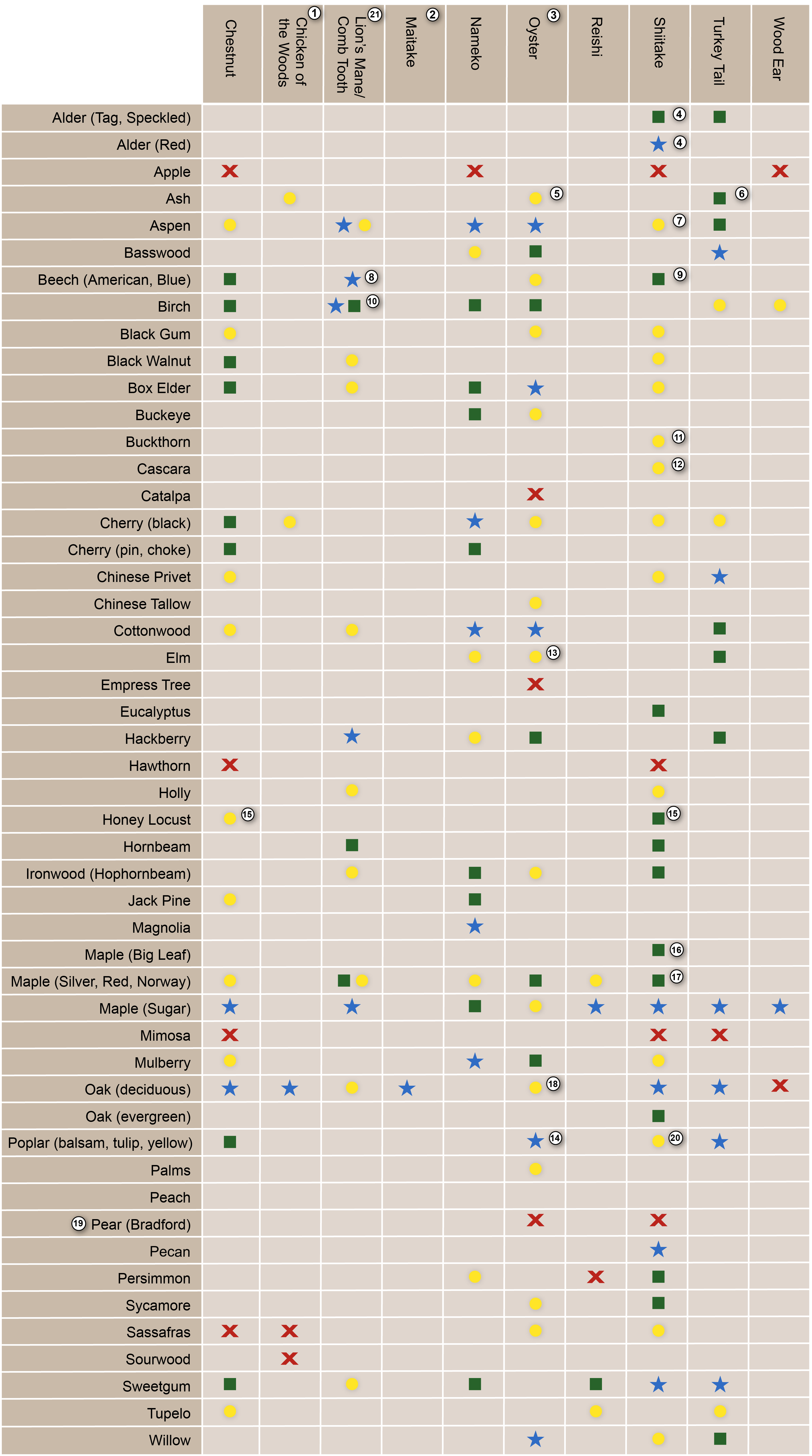
In 2022 Field and Forest Products launched an expanded wood testing program to gather as much information from growers around the country who offered to inoculate and collect results from untested (at least to the best of our knowledge) wood species. The following chart is a mix of personal experience here at FFP from over 40 years of trial and error and communication with customers in a variety of climate zones and tree species. We continue to update with reports from Citizen Scientists and have included extensive footnotes that may give a clearer picture on the performance of the projects. However, keep in mind that certain factors (listed below) may contribute to contradicting results from testers.
1. Expectation and subjective evaluation: A tester’s idea of listing a species as “recommended” may vary from tester to tester. Success can be subjective!
2. Wood harvest and storage/ inoculation rate: Dry wood or the inoculation of dead wood can greatly affect the success or failure of a wood species to bear mushrooms
3. Wood identification: Wood, especially dormant wood, can easily be mis-identified
There is bound to be contradictory results from many of you who have already tried some of these species with different results. If so, even if you concur or have valuable comment, we would love to hear from you. Please send an email to citizens@fieldforest.net. All of us who are dedicated to growing mushrooms on wood logs will appreciate your input!
CHART KEY
Star: superior, optimal wood species
Square: satisfying yield, worthwhile for the cost and effort of inoculation but not as good as “star” wood
Circle: small or infrequent crops or small percent of log population fruited. Also, fruiting of wild strains in the wild will indicate a potential match
X: no fruiting at all (until proven otherwise!)
Spaces in the chart that are unmarked indicate that these matches are untested. If you have the ability to test any of these and wish to participate in Field and Forest Products Citizen Science Program, please contact us at citizens@fieldforest.net or call us (800)792-6220
Footnotes:
1 & 2. Success based on steaming or sterilizing the log prior to inoculation
3. Oysters tested DO NOT include Pink oyster, King Oyster or Black Pearl as these strains are not meant for log cultivation
4. Thin bark, handle logs gently. Fast spawn run.
5. Wide range oysters work best (such as Summer White or Pohu Oyster)
6. Smaller mushrooms than other Turkey Tail, fruiting years 2&3
7. Good yield in the first year of fruiting but bark deteriorates quickly
8. Wood from early stage Beech Bark Disease works, mushrooms smaller and fewer than no Beech Bark Disease
9. Wood from early stage Beech Bark Disease works well, early yields good, comparative on unaffected Beech
10. White Birch fruits faster, overall yield between Birch species similar
11. Yields light but may be related to small diameters
12. Fast spawn run but single year fruiter
13. Use all-season Oysters such as Summer White, PoHu
14. Totems preferable to Drill and Fill inoculation method
15. Use Warm Weather Shiitake such as Night Velvet or Native Harvest
16. Fast fruiting but short lived
17. Thick barked logs best
18. Best results with Summer White
19. Wine Cap can fruit on bradford pear chips
20. Fruiting can minimally occur on very thick-barked logs
21. In all cases where there are two shapes, the more superior notation applies to Comb Tooth over Lion's Mane.