
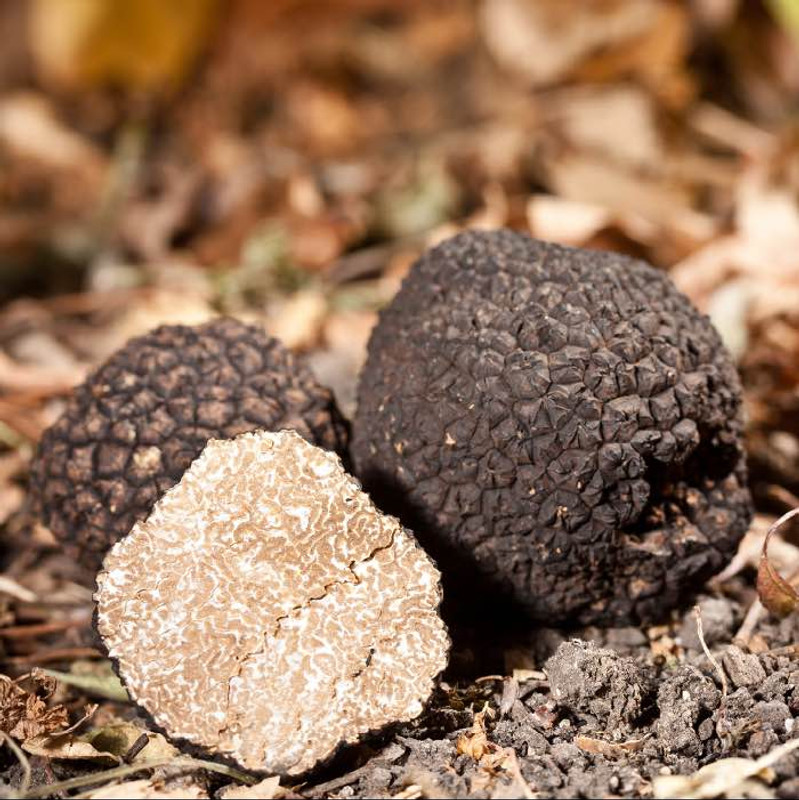
Welcome to the world of Truffle Cultivation! If you have never eaten a mushroom truffle, you owe yourself a taste. Earthy and nutty, they have a distinct, rich flavor that spreads across the tongue and into the nose.
Truffles are different than any other mushroom... different in the way they are grown and harvested, how they are prepared in the kitchen, and how much it costs to buy one! Truffles are an ecological group of fungi that grow and mature underground in association with tree roots, nourished by the carbohydrates shared by the roots of a host tree. The truffle fungus gives different valuable nutrients back to the tree roots in exchange. The "mushrooms", or spore bearing reproductive units, are acorn to walnut to tangerine-sized balls with a tough covering that encases the maturing spores within. (Picture a chocolate ganache ball enrobed in bittersweet chocolate... the chocolate truffle!) When the truffle spores mature underground, they have evolved to emit a fragrance that will attract truffle loving creatures (including humans) and signal that the mushroom is ready to eat. Once carried away and consumed, the spores are digested unscathed, thereby effectively ensuring it's survival in a new forest location.
About Truffles
Truffle fungi, aside from their edibility status, are important in the forest ecosystem. These are an important food sources world-wide for all kinds of mycophagist mammals (squirrels, flying squirrels, mice and others). While there are well over 140 species of truffles, only a handful are recognized as culinary fungi with significant market value, but that number is growing as truffles are better understood and researched in the USA.
Edible (and coveted) Truffle Species
The most coveted of truffles have traditionally been the White (Alba) truffle and the Black truffle (aka Perigord Truffle), famously grown or collected in Europe and exported to the USA. Recent advancements in the mushroom sciences have brought truffle cultivation to new heights in North America where now different Tuber species are being evaluated for cultivation. Each species has its own flavor signature and cultivation specifics. While certain regions of the USA have established truffle orchards including the above varieties, growers are testing other species to expand their offerings and success rate. One of the most common successfully cultivated truffles with a track record is the Burgundy Truffle, grown from the eastern seaboard through the Midwest wherever Oak and American Hazelnuts can thrive.
Truffle Cultivation
Commercial growers purchase inoculated trees that have the specific truffle fungus established in the roots of the tree. The trees are planted in an open area in the spring, kept weed free, watered and protected from rabbits and deer while approaching their truffle bearing years. Site selection is critical to the success of the truffle orchard. Truffle trees do best when planted into converted agricultural or orchard land as the soil is rich in bacteria (rather than forest fungi) which will not compete with the establishing truffle fungus. The soil needs to be well-drained and above pH 7.0, preferably pH 7.5. PH levels can be adjusted with the addition of lime and worked in as the orchard soil is plowed. If sod is being broken for the orchard, after plowing, the soil will need to be disked to prepare and level the planting site. The site should receive at least 6 hours of direct sunlight per day during the first 5 years.
Truffle Orchard Site Selection:
2. Select an area that can be easily maintained and free of weeds
3. Make sure the area has access to water in case of a dry year. One inch of water per week is desireable in the root zone, especially if the soil is sandy or rain is lacking.
4. Cage the trees if browsing deer and rabbits are a problem
How many truffle trees to plant?
Because of the complicated mating nature of the truffle fungus, it is best to plant a variety of tree species, and more than one of each. For truffle mycelium to form actual truffles, they need different mating types. The more trees you plant, the better the chances are that they will find a compatible type to make the tubers. At the very minimum, plant two trees, though we recommend at least 4.
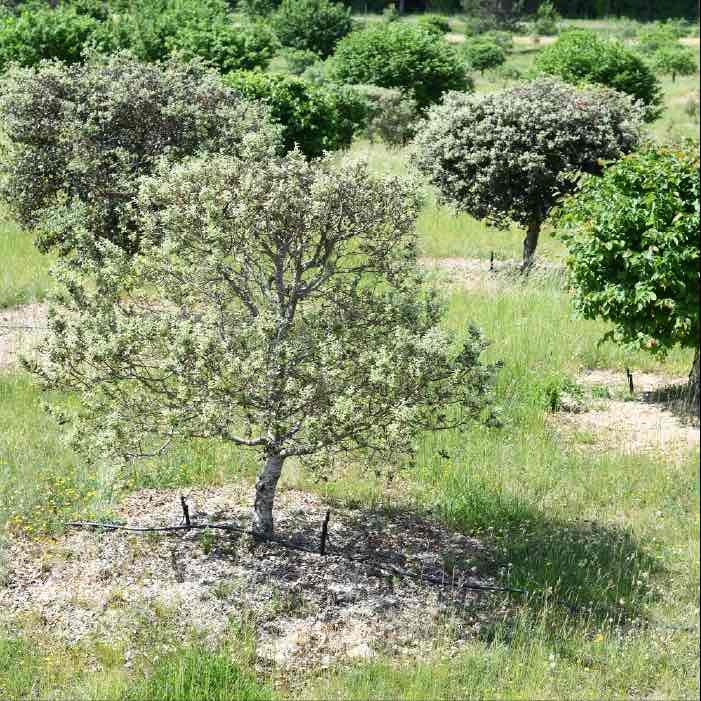
We offer our trees in 2 tree species, Oak and Hazelnut, to increase your chances of success. The tree roots are inoculated with the Burgundy Truffle (Tuber aestivum) which is adapted to our North American climate and can be harvested in the fall before the soil freezes. Seedlings should be planted 4-12 ft apart (depending on tree species), kept weed free, and mulched with limestone gravel if possible to keep soil pH high. By the time truffles begin to produce, there will be adequate shade cast by your seedlings' collective planting which is ideal for Burgundy truffle production. Plant the trees in a row or cluster so that they can begin shading the soil in a few years. Hazelnut trees should be planted as a pair to aid in pollination.
What to Expect When Ordering
Our truffle seedlings are six to eight months in the making and are produced by a leading truffle seedling producer in the United States. They are sold in sets of four consisting of two each of Oak (Quercus robur) and American Hazel (Corylus americana) or sets of 10 consisting of four Oak (Quercus robur), four American Hazel (Corylus americana), and 2 Siberian Hazel (Corylus heterophylla). (Sorry, no substitutions!) The seedlings are inoculated with the Burgundy Truffle (Tuber aestivum) which is well suited to mid-central and northern climates. Seedlings are guaranteed to have an established culture of the Burgundy truffle on their roots. Be aware that you are purchasing an inoculated seedling which may range in height from 4 to 8 inches. They are small, but grow fast!
*Note: Hazelnuts are not self-fertile and require more than one tree to cross-pollinate for nut production. Siberian Hazels have compatible pollen for American Hazels. Flowers are wind pollinated so plant the trees in a cluster or row near one another.
Seedlings are shipped in March/April and should be planted as soon as possible after they are received. If this is not possible seedlings may be stored refrigerated but the root ball must be kept moist and never allowed to dry out. If circumstances arise that prevents you from planting your seedlings, put them in potting soil with a pH of 7+. If you are unsure of the pH you can mix 2-4 cups agriculture lime (do not use hydrated or quick lime) to the potting soil. Do NOT let the pots dry out! While it is much better to plant in the spring, people have been successful potting their seedlings and planting in fall.
If you are interested in a larger scale orchard planting, contact us and we can put you in touch with the appropriate guidance.
Planting you Seedlings
Work the soil well, making sure it is free from perennial grass roots. If you have not tested the soil for a pH of 7-7.5, add one pound of agricultural lime/sq ft. That may seem like a lot, but lime dissolves and moves very slowly and is therefore difficult to over-lime. Remember that the tree roots will continue to grow out so getting a soil test and adjusting the soil pH for 10 ft beyond the tree cluster or row is ideal.
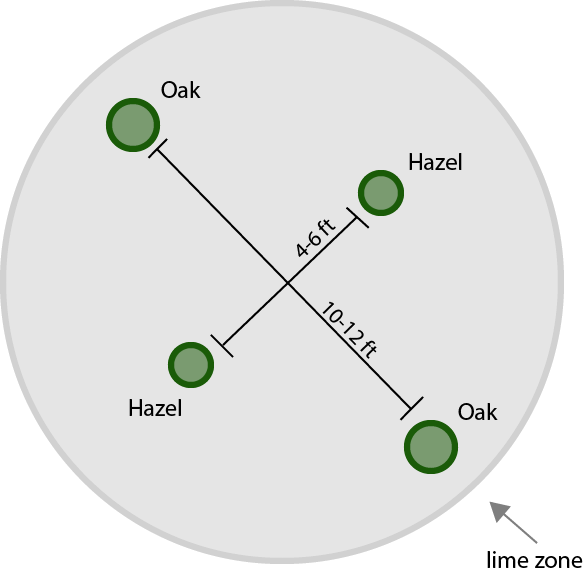
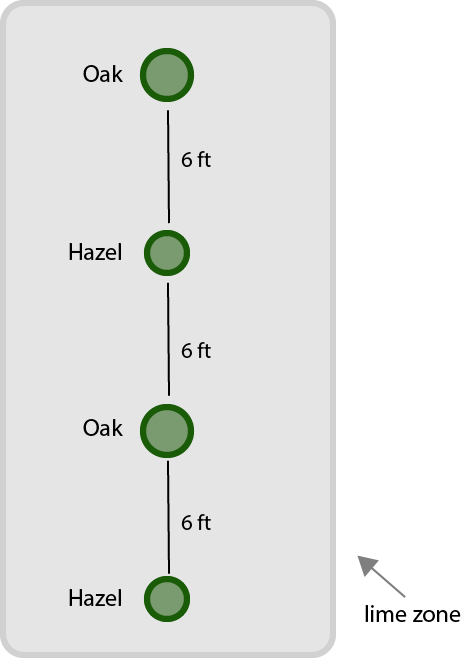
Dig an 8" diameter and deep hole and fill half full with water to ensure proper soil moisture. Place the seedling in the hole, but do not plant too deeply- one inch above where the first roots appear is perfect. Back fill, making sure the roots are gently fanned out. Do NOT let the root ball dry out at anytime during the process, but do not soak the roots prior to planting. Make sure to have tree protection in place after planting to deter deer and rabbits.
Truffle Harvest
Truffles should only be harvested when they are dead ripe, like a peach. Fortunately, many critters will also smell them and you will notice by their activity that ripening might be occurring. For people that have a dog, you can train your dog to sniff out ripe truffles for you! While there are certain truffle dog breeds, any dog with a good nose can be trained with truffle oil in a scent-and-reward technique. This of course is harder with just a few trees and your dog may lose interest if truffles are slow in coming, so you have to keep at it!
Establishing a truffle orchard requires a great deal of research and preparation, not to mention acquisition of truffle-infected tree seedlings. Truffle cultivation is not for those people in a hurry. Depending on truffle orchard management, initial crops generally appear in five years however once producing, truffle trees will continue to produce for decades. Plus, you get a few beautiful trees and Hazelnut shrubs, important species for the food forest regardless of the truffle crop.
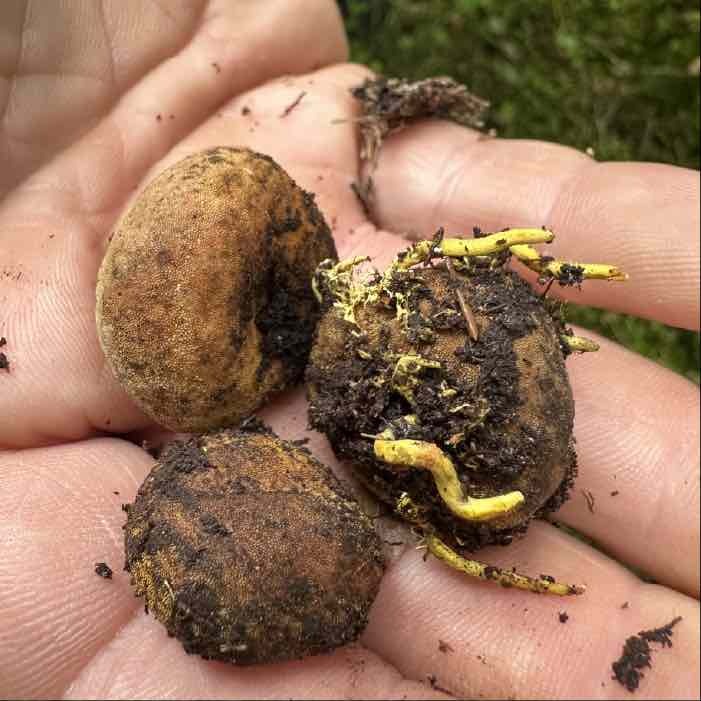
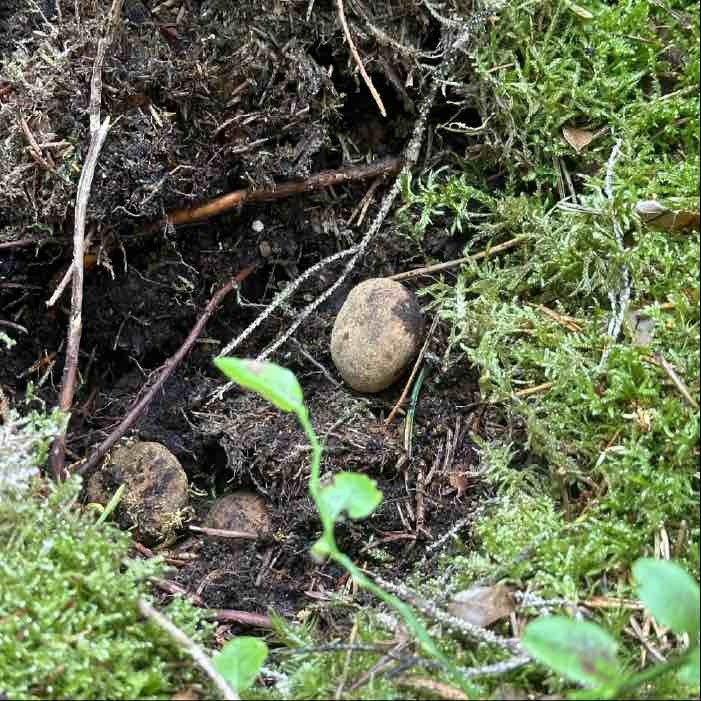
Above- native deer truffle with wild cordyceps
Note: Our trees are guaranteed to be infected with the Tuber aestivum fungus. However, we cannot guarantee truffle production or any quantity of harvest. Consider joining North American Truffle Growers Association. The relatively small membership fee provides the deep dive into cultivation in the US, plus lots of members are willing to share their expertise and dog pictures :-).